

A travel manager opens the monthly report and notices a familiar problem. Several trips were booked outside the company’s preferred channels. A few approvals were delayed. Finance has requested clearer reporting on travel spend. Meanwhile, employees expect faster booking and smoother travel support.
Corporate travel has always involved coordination across many moving parts. Booking flights, managing approvals, tracking expenses, ensuring policy compliance, and supporting travellers during disruptions all require time and precision.
This is where AI and automation in corporate travel are beginning to make a measurable difference. Companies are moving away from manual workflows and fragmented tools toward intelligent systems that streamline bookings, enforce policies, and provide real-time travel insights.
In this guide, we explore how artificial intelligence and automation are transforming corporate travel management, what benefits organisations are already seeing, and how companies can prepare for the next generation of travel technology.
Why Corporate Travel Needed Smarter Technology
Traditional corporate travel programs rely heavily on manual processes. Travel managers often spend significant time reviewing requests, verifying policies, and consolidating expense data.
This approach creates several challenges:
- Slow approval cycles
- Limited visibility into travel spending
- Frequent policy exceptions
- Fragmented reporting across departments
As companies expand across cities such as Mumbai, Bengaluru, and Delhi, travel volumes increase and these challenges multiply.
Automation allows organisations to simplify these processes while maintaining stronger control over travel programs.
Industry research from the Global Business Travel Association shows that technology adoption remains one of the strongest drivers of efficiency in modern travel management.
What AI and Automation Mean for Corporate Travel
Artificial intelligence and automation work together to streamline travel management tasks that were previously handled manually.
Automation
Automation focuses on executing routine tasks without human intervention.
Examples include:
- Automatic travel approvals based on policy rules
- Expense report generation
- Invoice reconciliation
- Booking confirmations and notifications

Artificial Intelligence
Artificial intelligence adds an additional layer of intelligence by analysing data and making recommendations.
AI systems can:
- Suggest optimal travel options
- Identify policy violations
- Predict travel cost patterns
- Recommend cost-saving opportunities
Together, AI and automation allow companies to manage travel programs with greater speed and accuracy.
How AI Is Transforming Travel Booking
One of the most visible changes in corporate travel is the way employees search for and book trips.
Intelligent Travel Recommendations
AI-powered platforms analyse past booking patterns and traveller preferences to recommend the most relevant options.
For example, an employee frequently travelling between Chennai and Hyderabad may receive recommendations that prioritise preferred airlines or convenient flight schedules.
Airlines such as IndiGo and Air India operate multiple daily flights on these routes, giving AI systems several options to optimise for price and timing.
Policy-Compliant Booking Suggestions
AI tools can automatically filter travel options based on company policy guidelines.
Travellers may see:
- Flights within approved price ranges
- Preferred hotels within negotiated rates
- Travel options aligned with corporate agreements
This reduces the likelihood of out-of-policy bookings and simplifies decision making for employees.
Automating Travel Approvals and Workflows
Approval delays are one of the most common bottlenecks in corporate travel programs.
Automation removes this friction by using predefined policy rules.
Automated Approval Systems
Instead of waiting for manual approvals, travel requests can be automatically approved when they meet policy criteria.
For example:
- Flights below a specified price threshold
- Travel within approved routes
- Trips booked within the required advance booking window
If a request falls outside the policy, it can automatically escalate to the appropriate manager.
Faster Travel Planning
Automation reduces administrative overhead and allows travellers to finalise bookings quickly.
Benefits include:
- Shorter approval timelines
- Reduced administrative workload
- Faster trip confirmations
Travel managers can focus on strategic tasks rather than reviewing routine approvals.
Improving Expense Management Through Automation
Expense management has traditionally been one of the most time-consuming aspects of corporate travel.
Automation simplifies this process by linking booking data with expense reporting.
Automatic Expense Capture
When employees book travel through an integrated platform, expense details can be captured automatically.
This includes:
- Flight costs
- Hotel charges
- Ground transportation expenses
The system can generate expense reports without requiring manual entry.
Faster Reimbursements
Automated expense workflows help finance teams process reimbursements more efficiently.
Employees benefit from quicker payments, while finance teams gain clearer visibility into spending patterns.
AI-Powered Insights for Travel Managers
AI tools do more than automate tasks. They also analyse travel data to provide actionable insights.
Travel Spend Analysis
AI systems can identify trends across travel data, such as:
- High-cost routes
- Frequent last-minute bookings
- Departments with rising travel expenses
For example, frequent travel between Delhi and Singapore might reveal opportunities to negotiate better airline rates.
Predictive Cost Forecasting
AI can also predict future travel costs based on historical data and market trends.
These forecasts help finance teams:
- Plan budgets more accurately
- Anticipate seasonal price increases
- Adjust travel policies when needed
Predictive insights allow companies to move from reactive cost control to proactive planning.
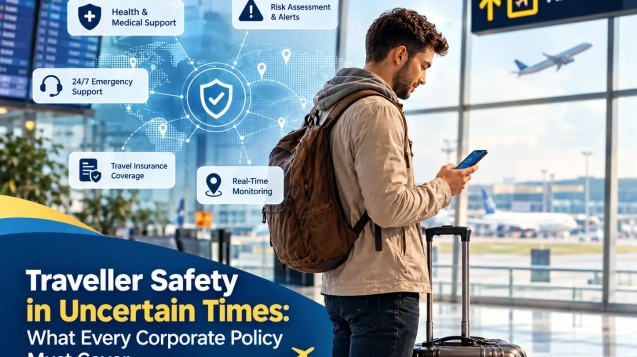
Enhancing Traveller Safety with Intelligent Systems
Traveller safety remains a top priority for corporate travel programs.
AI and automation help companies respond more quickly to disruptions.
Real-Time Travel Alerts
Modern travel management systems monitor global events and travel disruptions.
Employees travelling through cities such as Dubai or London can receive alerts about:
- Weather disruptions
- Flight cancellations
- Security advisories
Location Visibility
Travel platforms can also provide visibility into employee travel locations.
This allows companies to quickly identify travellers who may be affected by unexpected events.
During emergencies, organisations can communicate with travellers and arrange support or alternative routes.
AI Chat Assistants in Corporate Travel
Another emerging trend is the use of AI-powered chat assistants.
These tools help travellers manage their trips more easily.
Common capabilities include:
- Searching for travel options
- Providing itinerary updates
- Answering policy-related questions
- Offering support during disruptions
AI chat assistants are available at any time, which reduces the burden on travel support teams.

Balancing Technology with Traveller Experience
While automation brings efficiency, the human experience remains important.
Corporate travellers often face tight schedules, unfamiliar environments, and unexpected disruptions.
Travel technology should focus on improving the traveller journey rather than simply enforcing policies.
Examples include:
- Simplified booking interfaces
- Personalised travel recommendations
- Responsive support during disruptions
When technology supports both compliance and convenience, employees are more likely to adopt it willingly.
Preparing Your Organisation for AI-Driven Travel Management
Adopting AI and automation requires thoughtful implementation.
Companies should begin by evaluating their current travel processes.
Review Existing Workflows
Identify manual tasks that consume time and create delays.
These may include:
- Travel approvals
- Expense reconciliation
- Data consolidation for reporting
Automation can significantly reduce administrative effort in these areas.
Integrate Travel Systems
Travel booking tools, expense platforms, and reporting dashboards should work together.
Integrated systems ensure consistent data flow and more accurate reporting.
Train Employees on New Tools
Technology adoption improves when employees understand how tools benefit their daily work.
Short training sessions can help travellers learn how to:
- Book policy-compliant trips
- Submit expenses efficiently
- Use travel support features
Employee engagement plays a critical role in successful technology adoption.
Frequently Asked Questions
How is AI used in corporate travel management?
AI is used to analyse travel data, recommend travel options, predict spending trends, and automate tasks such as booking approvals and expense reporting.
What are the benefits of automation in corporate travel?
Automation reduces manual workload, speeds up approvals, improves policy compliance, and provides real-time visibility into travel spending.
Can AI help reduce corporate travel costs?
Yes. AI can identify cost-saving opportunities, recommend lower-priced travel options, and highlight spending patterns that require policy adjustments.
Is AI replacing travel managers?
AI does not replace travel managers. Instead, it assists them by automating routine tasks and providing insights that support better decision making.
How does automation improve traveller experience?
Automation speeds up bookings, simplifies expense reporting, and provides travellers with real-time updates about their trips.
What should companies consider before adopting travel automation?
Companies should evaluate their travel policies, integrate booking and expense systems, and provide training to ensure employees can use the new tools effectively.
Final Thoughts
Corporate travel programs are evolving quickly. Manual workflows and disconnected systems no longer meet the needs of modern organisations.
Artificial intelligence and automation are helping companies create travel programs that are more efficient, transparent, and responsive to traveller needs.
By automating routine tasks, analysing travel data, and supporting employees throughout their journeys, organisations can build travel programs that balance cost control with convenience.
Companies that embrace these technologies today will be better positioned to manage travel growth, control expenses, and deliver a smoother experience for their travellers.
If your organisation is exploring ways to modernise its travel management approach, consider implementing a platform that combines automation, intelligent insights, and seamless booking capabilities.
Book a demo today to discover how AI-powered travel management can transform your corporate travel program.