

Your company may have started with a simple travel booking process: an employee sends an email, a travel coordinator books the flight, the manager approves it, and Finance handles the expense later.
That process can work well when only a handful of employees travel. But as the business grows, travel booking process becomes harder to manage. More employees, destinations, suppliers, approval layers, and travel policies create more opportunities for delays, errors, and unnecessary spending.
The warning signs are usually easy to spot. Employees start booking through different channels. Managers spend too much time approving routine trips. Finance struggles to reconcile travel expenses. Travel teams become dependent on spreadsheets and email threads.
If several of these problems sound familiar, your business may have outgrown its current approach.
What Happens When a Travel Booking Process Stops Scaling?
A travel process does not necessarily become inefficient because it is old. It becomes inefficient when the volume and complexity of business travel grow beyond what the process was designed to handle.
A company with 50 travelling employees can often manage travel through a combination of email, spreadsheets, and a travel agency. A company with hundreds or thousands of travellers may have very different requirements.
The number of moving parts increases:
- More employees need to travel
- More managers need to approve bookings
- More destinations and suppliers are involved
- Travel policies become more detailed
- Finance needs better reporting
- Procurement needs supplier visibility
- Employees expect faster support
At some point, adding more people to the existing process does not solve the underlying problem. The process itself needs to become more structured.
Here are five signs that it may be time to reconsider how your organisation manages business travel.
1. Employees Are Booking Travel Through Too Many Channels
One of the clearest signs of a fragmented travel process is inconsistent booking behaviour.
Some employees may contact a travel agent. Others may use an online travel site. Some may book directly with airlines or hotels. Others may ask an assistant or colleague to make arrangements on their behalf.
Each method may seem convenient at the time. Collectively, however, they create a significant visibility problem.
When bookings happen across different channels, it becomes harder to answer basic questions:
- How much is the company spending on travel?
- Where are employees travelling?
- Which suppliers are being used?
- Are employees following the approved travel policy?
- How much travel is being booked outside preferred channels?
This also affects traveller support. If an employee’s booking details are scattered across emails, portals, and third-party systems, the company may struggle to locate the information quickly when plans change.
Why centralised booking matters
A corporate travel booking platform can bring flights, hotels, and other travel services into a single environment.
Employees have one place to search and book. Managers can follow approvals through a defined workflow. Travel and Finance teams gain a more complete view of activity.
The objective is not to force every employee into a complicated system. It is to give them a simpler way to book while giving the organisation better control.
2. Travel Approvals Are Slowing Down Business
Approval workflows often seem straightforward when travel volumes are low.
An employee sends a request. A manager replies. The booking is made.
As the organisation grows, that same process can become a chain of emails, reminders, follow-ups, and unanswered requests.
A manager may be travelling themselves. An approver may be unavailable. An employee may send a request without all the required information. The travel team may have to chase several people before confirming the booking.
The problem becomes more serious when airfare or hotel rates change while a request is waiting for approval.
Approval delays have a financial cost
Suppose an employee finds a flight at ₹18,000 and submits a request for approval. The approval arrives the following day, when the same fare costs ₹23,000.
The company has effectively paid ₹5,000 because of a process delay.
Multiply that across hundreds of bookings and the cost becomes significant.
Automated approval workflows can route requests to the appropriate approver based on predefined rules. They can also give employees and managers visibility into the status of a request.
This allows routine bookings to move faster while exceptions can receive additional review.
For businesses that are growing quickly, automated travel approvals can therefore be as important as the booking platform itself.
3. Finance Cannot Easily See the Full Cost of a Trip
A flight price rarely represents the complete cost of business travel.
A single trip may include:
- Airfare
- Hotel accommodation
- Ground transportation
- Meals
- Cancellation charges
- Change fees
- Visa expenses
- Insurance
- Other employee expenses
When these costs are recorded in different systems, Finance may have to manually consolidate them to understand the total travel spend.
That makes it difficult to identify trends or compare actual spending against budgets.
From expense reporting to travel spend visibility
A mature travel management system should connect travel activity with financial information wherever possible.
Finance should be able to examine spending by department, employee, destination, project, supplier, or travel category.
This allows a CFO or Finance manager to ask more useful questions.
Why did travel spending increase this quarter?
Which departments are exceeding their budgets?
Are employees booking outside approved channels?
Which suppliers account for the largest share of travel spending?
Where are policy exceptions occurring?
Without reliable data, these questions often require manual investigation.
AtYourPrice’s Travel Spend Analyzer is designed around this need. The platform brings travel data together to connect, track, analyse, and optimise corporate travel expenses, with capabilities including real-time spend tracking, policy compliance, custom reporting, vendor analysis, and budget forecasting.
4. Your Travel Policy Exists, but Employees Keep Bypassing It
A travel policy is only useful when it can be followed consistently.
Many organisations have policies covering flight class, hotel limits, advance booking requirements, preferred suppliers, and approval procedures. Yet employees may still book outside these rules.
There can be several reasons.
The approved booking process may be inconvenient. Employees may not know which suppliers are preferred. The available options may not suit a particular trip. Or there may simply be too many steps involved.
The result is often a gap between what the travel policy says and what employees actually do.
Policy compliance should happen during booking
A better approach is to bring policy rules into the booking process itself.
For example, if an employee searches for a flight that falls within the company’s approved criteria, the booking can proceed normally.
If the selection falls outside policy, the system can flag it or route it for additional approval.
This creates a more practical form of policy enforcement because employees see the relevant rules while making the booking.
It also gives Finance and travel managers data about where exceptions are occurring.
If a particular policy is repeatedly bypassed, that may indicate a process problem worth investigating.
5. Your Travel Team Is Spending More Time Managing Bookings Than Managing Travel
This is perhaps the most important sign.
Travel professionals should not have to spend most of their day searching through emails, updating spreadsheets, following up on approvals, and answering questions about booking status.
As travel volumes increase, manual administration can consume the time that should be spent on higher-value activities such as:
- Supplier management
- Travel policy improvement
- Cost analysis
- Traveller support
- Negotiating better rates
- Monitoring travel trends
- Improving the employee travel experience
If every increase in travel volume requires another increase in administrative work, the process is not scaling efficiently.
Automation changes the role of the travel team
Automation can handle repetitive activities such as:
- Booking workflows
- Approval routing
- Policy checks
- Notifications
- Reporting
- Travel data consolidation
This gives travel teams more time to manage the areas where human judgement matters.
The goal is not to remove people from travel management. It is to remove unnecessary manual work from their day.
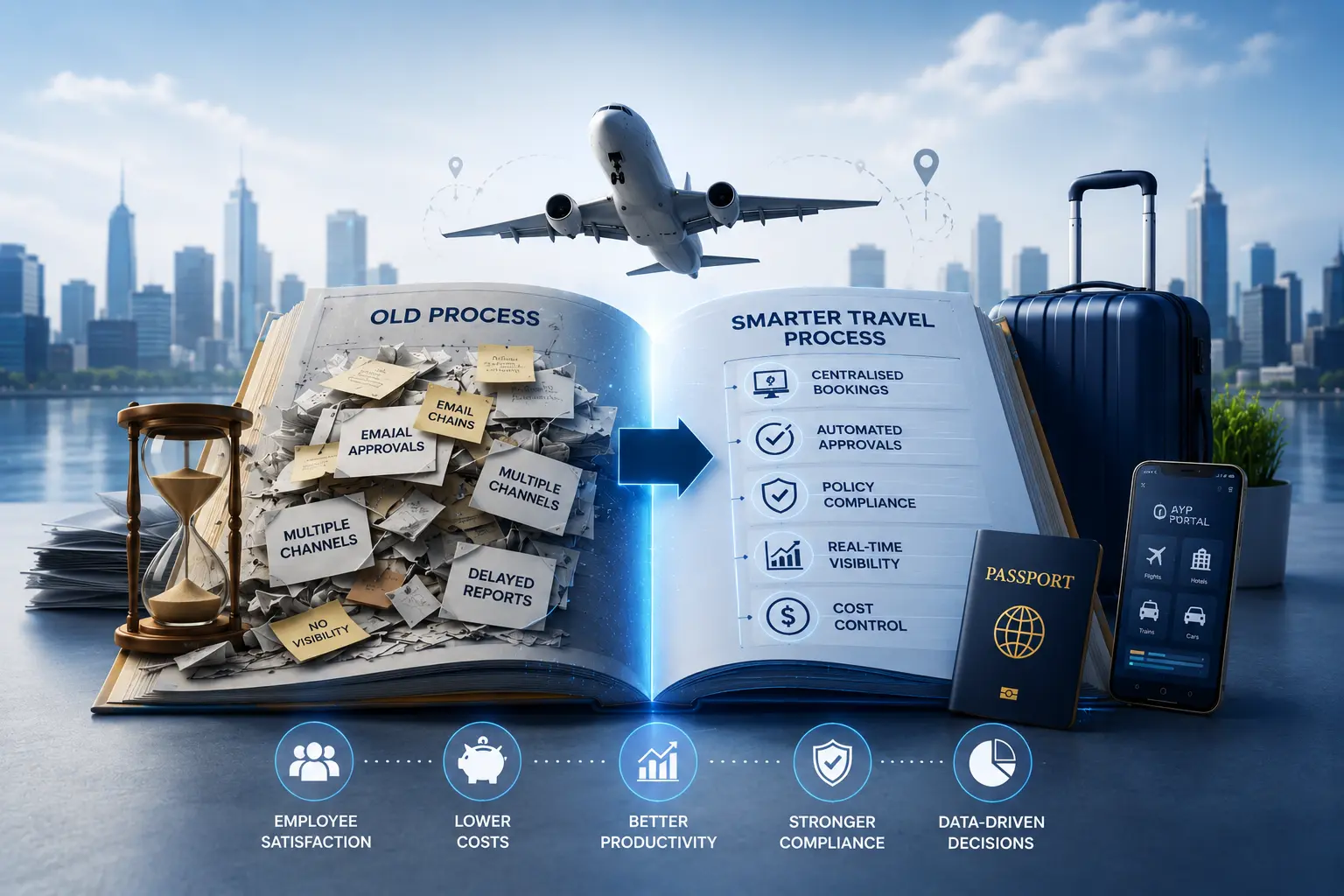
What a Scalable Corporate Travel Booking Process Looks Like
A scalable travel process should make life easier for both employees and the teams responsible for managing travel.
At a basic level, it should connect the following stages:
Search → Book → Approve → Travel → Track → Analyse
Each stage should contribute information to the next.
Employees should have access to relevant travel options through an approved channel. Managers should be able to review requests quickly. Finance should receive accurate travel information. Management should have access to reports that support budgeting and cost control.
A centralised platform can make this possible without requiring every department to maintain separate records.
AtYourPrice, for example, brings corporate travel services and management functions together, covering areas such as flights, hotels, buses, cabs, trains, visa, insurance, approvals, policy enforcement, invoicing, and travel analytics.
The broader benefit is a more connected travel programme where information does not have to be manually transferred from one team to another.
Before Replacing Your Current Process, Ask These Questions
Outgrowing a travel booking process does not automatically mean that you need to replace every system you currently use.
Start by identifying where the actual problems exist.
Ask:
Can we see all business travel in one place?
If not, determine which booking channels are creating the gaps.
How long does a typical approval take?
Look at the average time and identify where requests are getting stuck.
How much travel is outside policy?
Measure exceptions rather than assuming that employees are following the rules.
How much manual work goes into reporting?
Calculate the time spent collecting, cleaning, reconciling, and presenting travel data.
Can Finance identify savings opportunities?
A report that only shows historical spending may not be enough. Finance needs information that supports decisions.
These questions can help determine whether the problem is a policy issue, a workflow issue, a technology issue, or a combination of all three.
When Is It Time to Move to a Corporate Travel Platform?
There is no single employee count or travel volume at which every company needs a travel management platform.
The better indicator is complexity.
If your organisation is experiencing several of these issues at the same time, it may be time to consider a more connected approach:
- Multiple booking channels
- Slow approval cycles
- Limited travel spend visibility
- Low policy compliance
- Increasing manual work
- Fragmented supplier data
- Difficulty supporting travellers
- Growing travel volumes
A scalable system should grow with the business rather than require more manual effort every time travel activity increases.
Frequently Asked Questions
What is a corporate travel booking process?
A corporate travel booking process is the system a company uses to request, approve, book, manage, and track employee business travel. It may include travel policies, approval workflows, booking platforms, suppliers, expense management, and reporting.
How do I know if my company needs a corporate travel management platform?
Growing travel volume, multiple booking channels, slow approvals, limited reporting, and poor policy compliance are common indicators. The complexity of your travel programme is often a better indicator than employee count alone.
How can companies improve their travel booking process?
Companies can improve the process by centralising bookings, automating approvals, integrating travel policies into booking workflows, consolidating travel data, and providing better reporting and traveller support.
What are the benefits of centralised corporate travel booking?
Centralised booking can improve visibility, policy compliance, approval management, reporting, traveller support, and supplier control. It can also reduce the administrative effort involved in managing travel across multiple channels.
How does travel booking automation reduce costs?
Automation can reduce costs by helping employees follow travel policies, speeding up approvals, improving booking visibility, identifying spending patterns, and reducing manual errors.
Conclusion
A travel booking process can work perfectly well for a small organisation and become a serious operational constraint as the company grows.
The warning signs usually appear gradually. Employees start using different booking channels. Approvals take longer. Finance struggles to consolidate spending. Travel policies become harder to enforce. Travel teams spend more time managing administration and less time improving the programme.
These are signs that the process has become more complex than the system supporting it.
A modern corporate travel platform can bring bookings, approvals, policies, expenses, reporting, and traveller support into a more connected workflow. That gives employees a simpler booking experience while giving Finance, HR, Admin, and leadership greater visibility and control.
If your current travel process is becoming harder to manage as your business grows, it may be time to rethink how corporate travel is handled. Book a demo with AtYourPrice to see how a centralised travel management platform can simplify bookings, automate approvals, improve policy compliance, and give your business better visibility into travel spending.